Redeemables | Restaurant Gift Cards
How to Sell Gift Cards for Your Restaurant (2026)
 Jules AgarUpdated
Selling restaurant gift cards gets you paid for a meal before anyone sits down. This guide is for the owner who wants to start before the holidays: what to sell, what it really costs, the rules to set on day one, and how a guest redeems a gift card at the table.
We'll use a real example throughout: Bonaloi, a Paris restaurant group that sells its own menus as vouchers from its page on Paage for restaurants.
Facts and prices were checked on October 19, 2026.
Gift cards or set-menu vouchers: which should you sell?
On Paage, there are two formats:
-
Gift Card: an amount the recipient spends at your restaurant. You offer preset amounts or custom ones, or let the buyer choose the exact value.
-
Voucher: a defined experience, like a set menu for two or a tasting dinner. The price is fixed, and the buyer knows exactly what they're giving.
The defined experience is what most people buy. In MyBeezBox's 2022 sales data, 86% of sales were vouchers for a defined experience, against open-amount gift cards.
Our advice: sell both, and lead with your menus. The voucher is the gift people come for. The gift card catches everyone who'd rather let the recipient choose.
Why gift cards bring in cash before the meal
A gift card turns the usual order around: the guest pays now, and you serve later. The money is in your account before the table is set.
That's useful in the months when tables are hardest to fill. Gift cards sold in December are cash in hand for January and February, for rent, payroll and suppliers, without waiting for the dining room to fill up.
Turn your menus into vouchers: the Bonaloi example
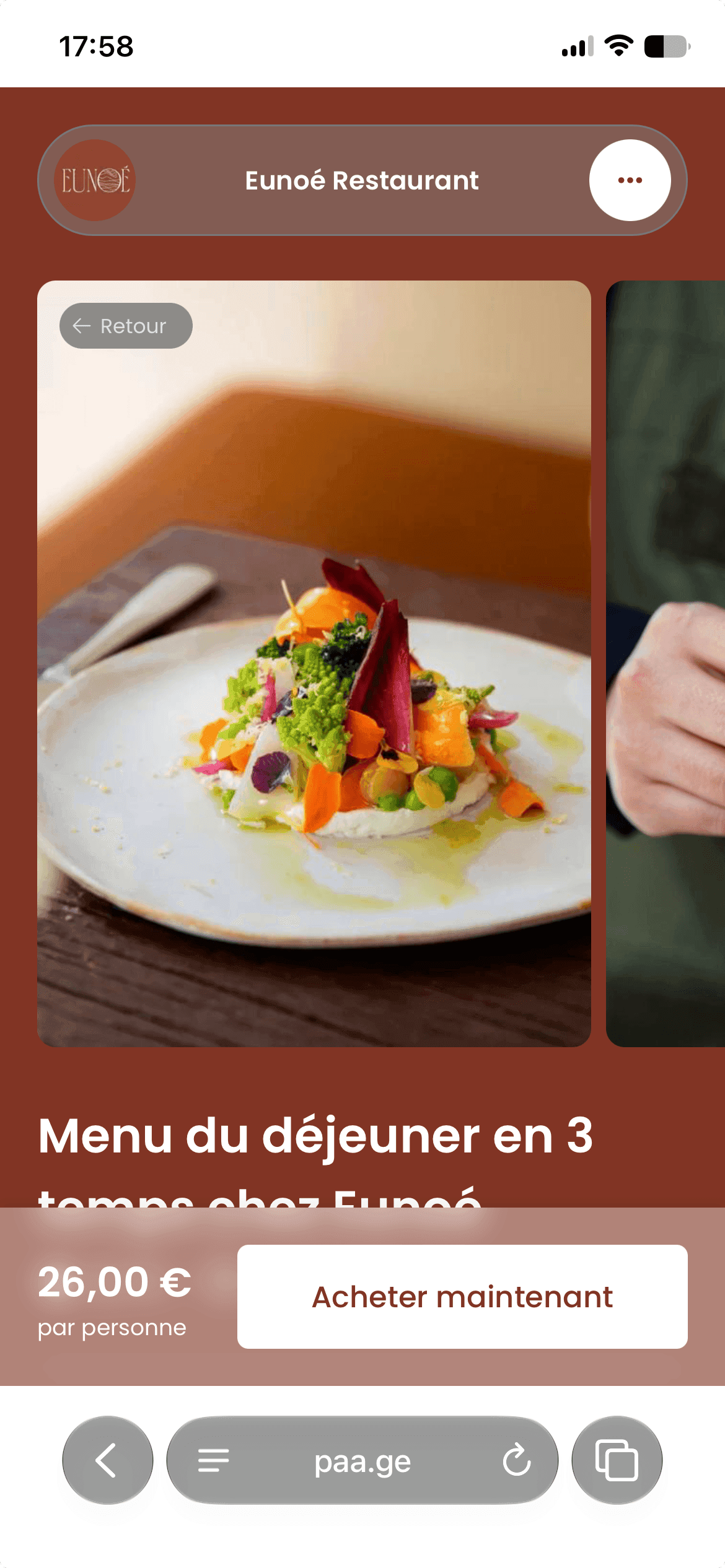
Bonaloi runs "Cuisine Altruiste", three Paris restaurants open 7 days a week for lunch and dinner: Orgueil, Colère and Envie. Instead of only selling an amount, it sells its actual menus as vouchers.
Take Orgueil's Menu Mystère, a 7-course surprise menu to share:
-
Price per person: about $57.
-
Validity: 1 year.
-
Order size: 2 to 8 people per order.
-
Add-on: an optional glass of Champagne at about $17 per person.
The prices are converted from euros (1 euro = $1.1206, ECB reference rate of October 9, 2026).
In Bonaloi's words, on Paage for restaurants:
"Paage made it effortless for us to sell our gift vouchers online. It only took a few minutes to set up, and now our customers can buy and send vouchers directly from our page - no extra tools needed."
You can build the same kind of range for your own restaurant. The prices below are examples to adapt, not market data:
| Offer | Example price | Main occasion |
|---|---|---|
| Set menu for 2 | $80–150 | Valentine's Day, anniversary |
| Tasting menu with wine pairing | $120–250 | Mother's Day, Christmas |
| Family brunch or lunch | $60–100 | Birthday, retirement |
| Private cooking workshop | $80–200 | Birthday, group gift |
| Gift card (amount) | $50 / $100 / $150 | Any occasion |
Two tips for building the range:
-
Name the experience, not the service. "Candlelit dinner for two" sells better than "3-course set menu."
-
Offer three price tiers. A low, a middle and a premium option give every buyer a place to land.
When guests buy gift cards: the restaurant calendar
Gift cards are a December business first. MyBeezBox's 2022 sales data shows how concentrated it is:
-
40% of annual sales came between November 26 and December 27, 2022.
-
19% came in the 7 days before Christmas.
-
42% of gift-voucher purchases were made on mobile.
-
46% of purchases happened during restaurant service hours (11am–2pm and 6pm–10pm), exactly when you're too busy to take an order by hand.
After December, plan for the smaller peaks of the year:
-
February: Valentine's Day, for offers built for couples.
-
May: Mother's Day.
-
June: Father's Day, graduations and retirements.
The practical takeaway: put your vouchers online before late November, and make sure people can buy them on a phone at any hour.
Set the rules before you sell: validity, terms, and US expiry law
Decide the rules before the first sale, not when the first guest shows up with a code:
-
Validity: how long the gift card or voucher can be used, counted from the purchase date.
-
Single or multiple use: whether a gift card is used in one go or over several visits until the balance is spent.
-
Terms: blackout dates (Valentine's night, New Year's Eve), and how much notice a guest gives before booking. Write them on the recipient page, with your contact details.
In the US, validity isn't only your choice for money-value cards. Under federal rules in force since August 22, 2010, a gift certificate, store gift card or general-use prepaid card generally can't be sold unless its funds stay valid for at least 5 years after it's issued, or after money was last loaded onto it. Loyalty, award and promotional cards are excluded. State laws can add other rules.
The practical consequence: for a monetary gift card sold in the US, set the validity to 5 years or more, or to "perpetual". This is general information, not legal advice, so check your state's rules before you publish.
What it really costs to sell gift cards
Two costs apply to every gift card you sell online: the platform's fee, and card processing by your payment provider. Here is the platform fee alone, processing excluded on both sides:
| Tool | Platform fee per sale | Monthly subscription |
|---|---|---|
| Paage Free | 9% | None |
| Paage Basic | 9% | Yes, see plans |
| Paage Plus | 3% | Yes, see plans |
| Paage Pro | 1% | Yes, see plans |
| Gift Up | 3.49% per gift card, $0.50 minimum | None, and no setup fee |
On both, card processing is charged on top by your own payment provider.
Example: two guests buy Bonaloi's Menu Mystère with two glasses of Champagne.
-
Order: 2 × $57.15 + 2 × $16.81 = about $147.92 (converted prices, see above).
-
Paage Free (9%): 147.92 × 0.09 = about $13.31.
-
Paage Plus (3%): 147.92 × 0.03 = about $4.44.
-
Paage Pro (1%): 147.92 × 0.01 = about $1.48.
-
Gift Up (3.49%): 147.92 × 0.0349 = about $5.16, above its $0.50 minimum.
The honest reading: on the Free plan, Paage's 9% is higher than Gift Up's 3.49%. The paid plans cut the rate to 3% or 1%, but they add a monthly subscription. Paage's case isn't the lowest rate. It's what comes with it: the gift card sits on the same page as your menu, your reservation widget and your email list, and every buyer becomes a contact.
How to set up gift cards on Paage
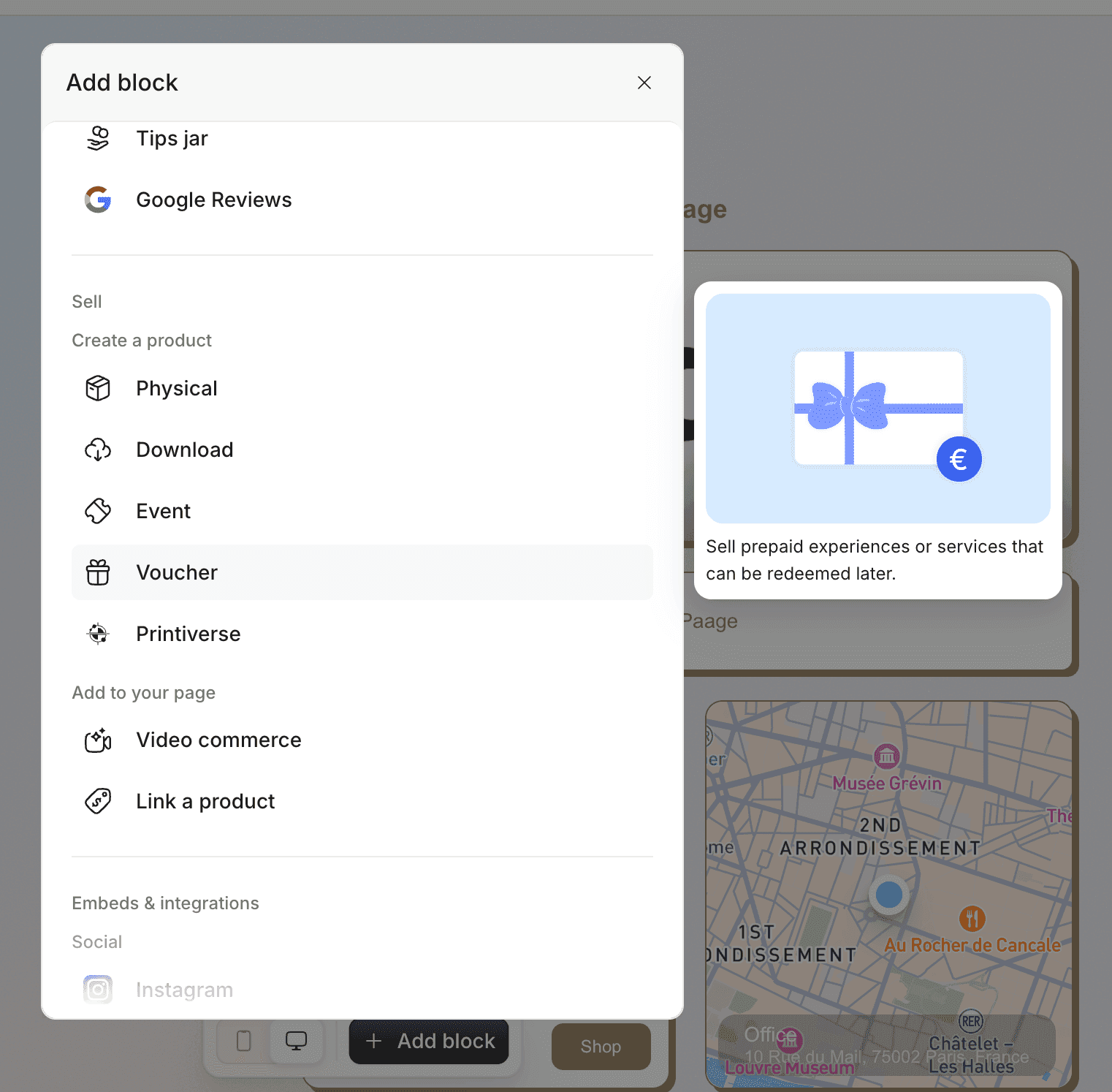
You set up a gift card or a voucher as a product on your page. Here's what you choose, according to the Paage help center:
-
Voucher or Gift Card: a Voucher (under Products › Vouchers) for a defined experience, a Gift Card for an amount.
-
Price: for a Voucher, per unit, per person or per couple. For a Gift Card, preset amounts, custom amounts, or the exact value the buyer chooses.
-
Validity: a number of days counted from the purchase date (30 or 365, for example), or perpetual.
-
Limits: units per purchase, a cap on the total sold, a purchase limit per customer, and an age restriction if you need one.
-
Extras: paid options and add-ons, like Bonaloi's glass of Champagne, and a "what's included" list.
-
Recipient page: your terms of use and contact details, with an optional booking module.
-
Publishing: as a standalone public link, or as a block on your page next to your menu.
To get paid, connect Stripe and/or PayPal: payments go to your own account. At checkout, guests pay by card, Apple Pay or Google Pay.
Redeeming at the table: codes, your POS, and your reservation tool
Selling the gift card is half the job. The other half happens at the end of a meal, when a guest hands over a code. The recipient receives that code, and your team enters or scans it.
If you use one of these POS systems, the code is redeemed from the till:
-
Lightspeed K-Series: staff tap the Paage button on the order, then enter or scan the code. The system verifies the voucher with Paage in real time. Tap "Use for Payment", then complete the sale.
-
Zelty: staff open Payment › Loyalty › Paage, scan or type the code, and select "Use for payment". Any remaining amount is paid normally, by cash or card. The code is then deactivated on Paage, so it can only be used once. If a redemption was a mistake, you can cancel it from the Paage dashboard.
Paage doesn't take table reservations. It works alongside your reservation tool: your TheFork, SevenRooms, CoverManager or Zenchef widget can sit on the same page as your gift cards. A guest can buy a voucher and book the table in the same visit.
Turn every buyer and recipient into a regular
Every gift card involves two people: the one who buys it, and the one who comes to eat. Both are new relationships for your restaurant.
On Paage, gift-card buyers become contacts you can email: a new menu, a quiet-night offer, an event. Newsletter sign-ups from your page join the same list. For more on running that list, see our guide to the best newsletter platforms for creators.
Eunoé puts it this way, on Paage for restaurants:
"With Paage, our customers buy a gift voucher in a few clicks, straight from our Instagram. It's simple for us to manage, and every voucher sold helps us stay in touch with both the people who give it and the people who receive it."
Beyond restaurants: spas, studios, stays
The same mechanics work for any venue that sells an experience. A spa, a yoga studio or a bed and breakfast can sell a Voucher the same way a restaurant sells a menu:
-
Price per person or per couple: a couples' massage, a class for two.
-
Packages: a stay with dinner, or a treatment with access to the spa, priced as one voucher.
-
A "what's included" list: so the buyer knows exactly what they're giving.
-
A location map: so the voucher is used at the right venue, which matters if you run more than one.
Promote your gift cards: bio, website, tables, inbox
-
Your bio: put the page with your gift cards in your Instagram and TikTok bio. Your link in bio is where followers click, so it's where they'll buy. Post a story or a Reel 3–4 weeks before each peak, and show the experience: the room, the plates, the people.
-
Your website: if you have one, embed your voucher page with Share › Integrate, then copy the HTML code.
-
Your tables: print a QR code to your page on the tables and the bill.
-
Your inbox: email your contacts before each peak. A good rhythm is 3 weeks before Christmas, 10 days before Valentine's Day and 2 weeks before Mother's Day.